Does global law really work?
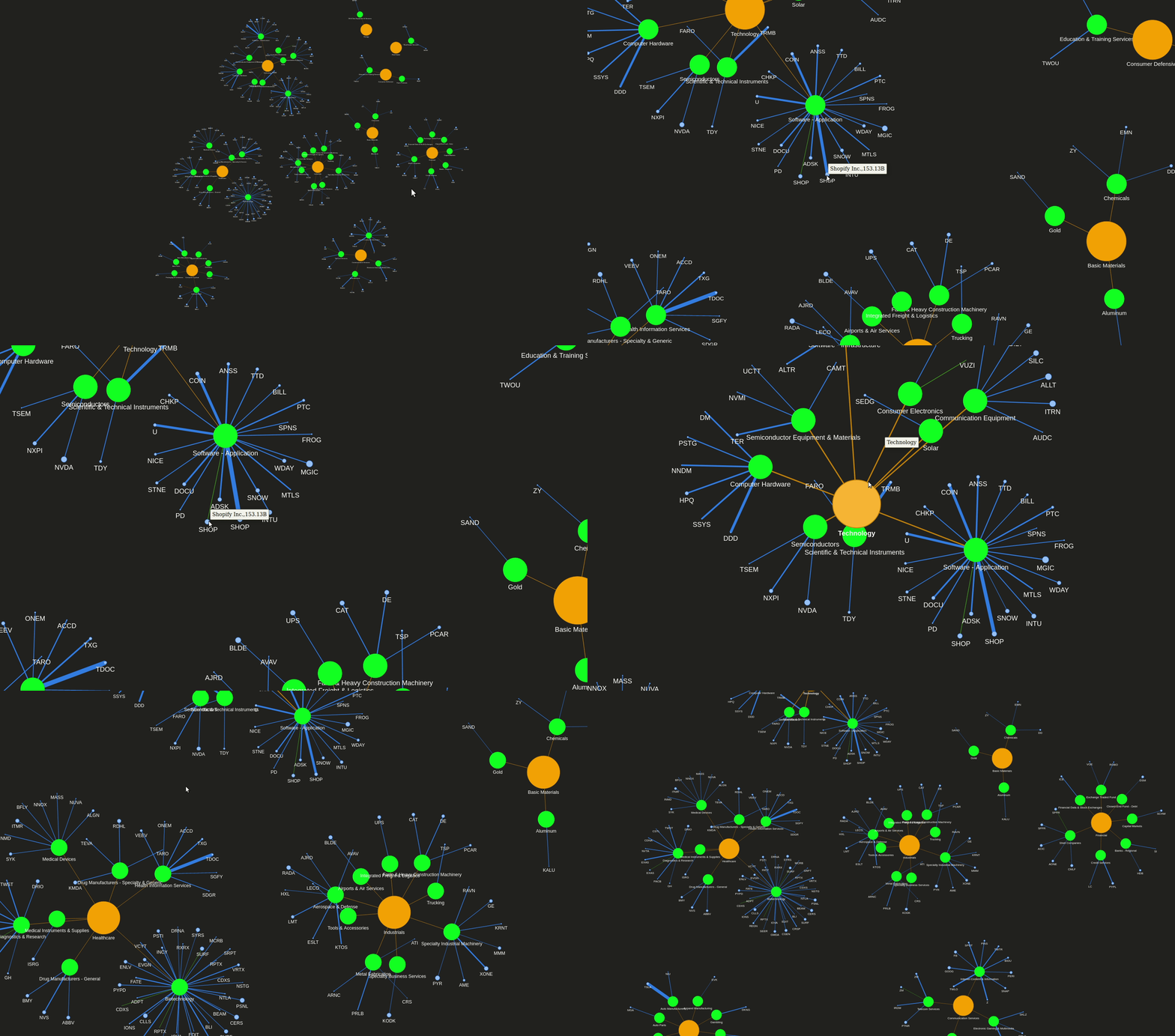
Final Ark graph — Image by Author (https://shyambv.com/ark_net.html)
As foreshadowed in my last two posts regarding Global Law (1st post, 2nd post), I shall conclude with Backer's last character of global law: 'polycentricity'.
4. Polycentricity
Polycentricity is the foundation of global law, which means governance can exist simultaneously in multiple systems of law. Norms and customs are being practiced widely by people outside of the legal framework, therefore, there is no single applicable law in the real world. Such norms do not evolve randomly, they involve culture, communities of practice etc. A few examples to illustrate polycentricity:
Example 1
A driverless car got into a car accident, who is responsible for the accident? Is it the car-owner? The manufacturer? The distributor? The manufacturer? The insurance company? What law shall we apply? Contract law, transport law or consumer law? Multiple actors including state and non-state are crossing each other's paths and are all being considered simultaneously.
Example 2
A gunman live broadcasting his shooting on Facebook, how many actors are here? The state government and Facebook. Facebook has its own terms binding the gunman and people who are watching the broadcast, while the government stepped in with domestic law that overlaps with Facebook's contractual terms. The contracts, the public norms, the regulations, the state government, the non-state actors are all involved in one incident. Everything is colliding with each other and these kinds of situations will happen a lot more frequently in the future with the advanced technology. Today, it is not the centralised government being the big boss, we have multiple systems of rules and we are part of the rules.
Example 3
The Beirut case, where the media crew of 60-minutes assisted Faulkner kidnapping her children in Lebanon. Before the kidnap, the children's custody lies with Faulkner in Australia. However, Elamine also successfully claimed custody of the children in Lebanon. Other than the conflicting state laws in the family law area, the case also involves media law, criminal law and international law. In addition, other than law, it also involves culture, family norms and recognition, social media rules and political power etc. There is no 'one law' that can apply to this case as it is impossible for that one law to recognise the legitimacy of other rules. Everything in global law is 'fractured'.
From these 3 examples, as global lawyers, we need to understand the complexity and conflicting characters of law, we shall not try to 'make things work' by forcing a 'one size fits all' framework. It is again about embracing the complexity and deterritorial nature of global law system.
I understand polycentricity in an additional way. In my last post, I briefly discussed the converging and diverging analogy in global law. If we are constantly building new systems every day, are we going to suffocate in the sea of information? The answer is no. When we look at the big system, we cannot use all the information in that big system. A lot of times, we need to focus one small area of that big system, then dig deep into that small area by expanding on that small area. After all, that small area will evolve into another new sub-system. However, that does not mean we are taking that small sub-system away from that big system, when a new question is asked, sometimes it is relevant to another corner in the big system that may have a relationship to that particular small sub-system. In short, legal education is not about linear question and answer sessions, it is about discussion, collaboration and cooperation. I got a chance to experience 'Miro' in one of my law classes, there are multiple discussions happening simultaneously and it is the perfect example of applying polycentricity in legal education.
What does that all mean in today's world?
Some critics claim that international law is weak law as it cannot interfere the domestic law within states. What significance does global law have? Do we even need global law?
I would argue that we need global law now and we need to establish global law thinking now. It is less about how practical these frameworks are applicable in our daily legal work, but more about the acceptance of the world outside of our traditional legal framework. Even though law is the second most-respected profession according to the World Economic Forum, it does not mean that we have to constantly stay in our respected comfort zone to maintain such prestigious status. Instead, we should foresee the global law framework as the most applicable legal framework in twenty years time. The world will not stop changing because you, as lawyer, stopped evolving, if the you stay the same for another 20 years, you may still earn a living as a lawyer in your good old area of law, but you will miss all the excitements and new opportunities with the global changes.
Pure optimism?
It is easier for me to discuss Backer's theory than applying his theory in practice. In reality, the powerful actors are usually reluctant to change as they want to maintain their powerful status. Government organisations usually take weeks to response to a citizen's regular request, imagine the time needed for one rule to be amended. I would not disagree that Backer's theory is impractical, but I would argue that such mindset is necessary for global law to evolve. As Backer states: 'while traditional law starts with the state and traces its relationship with the governed; global law starts with the governed and traces their relationship with and effects on the governance organs'. We need to reverse engineer as global lawyers. Start small, start from telling your best friend about it, start by answering in a different way when people ask you what kind of lawyer you are or start by posting a blog post like me, you will never know where this will end someday.
I hope this series won't back you off, we need an open mind and an open heart as global lawyers. I shall end with the most famous and amusing internet memes of all time with a personal touch of global law context. Thank you for reading!


Comments
Post a Comment